Best Ski Towns in France: 8 Alpine Villages Ranked by Character

Quick Answer
The best ski towns in France combine skiing access with genuine village character — not purpose-built stations, but places that exist beyond the lifts. Eight stand out: Megève (Rothschild-era elegance), Chamonix (mountaineering capital), Val d'Isère (old stone church and glacier access), Morzine (working market town in the Portes du Soleil), La Clusaz (Savoyard farming village), Samoëns (medieval stonecutter town), Les Gets (family-friendly), and Saint-Martin-de-Belleville (hamlet with Three Valleys access).
Choosing a French ski holiday often comes down to the town itself — its walkability, dining scene, architecture, and what happens after the lifts close. The French Alps span the full spectrum, from medieval market villages to high-altitude purpose-built stations. This guide focuses on the eight towns with genuine character: places where the streets, restaurants, and evening atmosphere are as much a reason to visit as the skiing.

What Makes a Great Ski Town (Not Just a Great Ski Resort)
A compelling ski town offers something a purpose-built station cannot: a sense of place that exists independently of the lifts. The best French ski towns share five qualities — historic architecture, a walkable centre, restaurants that draw locals year-round, a distinct evening atmosphere, and enough accommodation variety to suit different group sizes and budgets.
This ranking weights town character more heavily than terrain. Some entries sit within vast linked ski areas; others offer more modest piste networks but compensate with village life that purpose-built resorts simply cannot replicate. For a skiing-focused comparison, see our best ski resorts in France guide.
Megève: The Town That Invented the French Ski Holiday

Megève is the original French ski town — developed in the 1920s as an alternative to St. Moritz by the Rothschild family, and still carrying that era's architectural confidence. Its medieval centre, pedestrian since the 13th century, anchors a village where horse-drawn carriages share cobbled lanes with Michelin-starred restaurants and independent boutiques.
The town's character operates independently of skiing. Megève has three Michelin-starred restaurants, a weekly market that runs year-round, and a cultural calendar that predates the first ski lift. The church of Saint-Jean-Baptiste dates to the 14th century. The Palais des Sports hosts concerts and exhibitions. This is a town first, a ski resort second.
The skiing connects to the 445-kilometre Evasion Mont-Blanc network — substantial, if less convenient than the Trois Vallées. Runs tend toward intermediate terrain, with the Côte 2000 sector offering the most challenging descents. The trade-off for Megève's low altitude (1,113m) is occasional snow unreliability below 1,500 metres in warm winters.
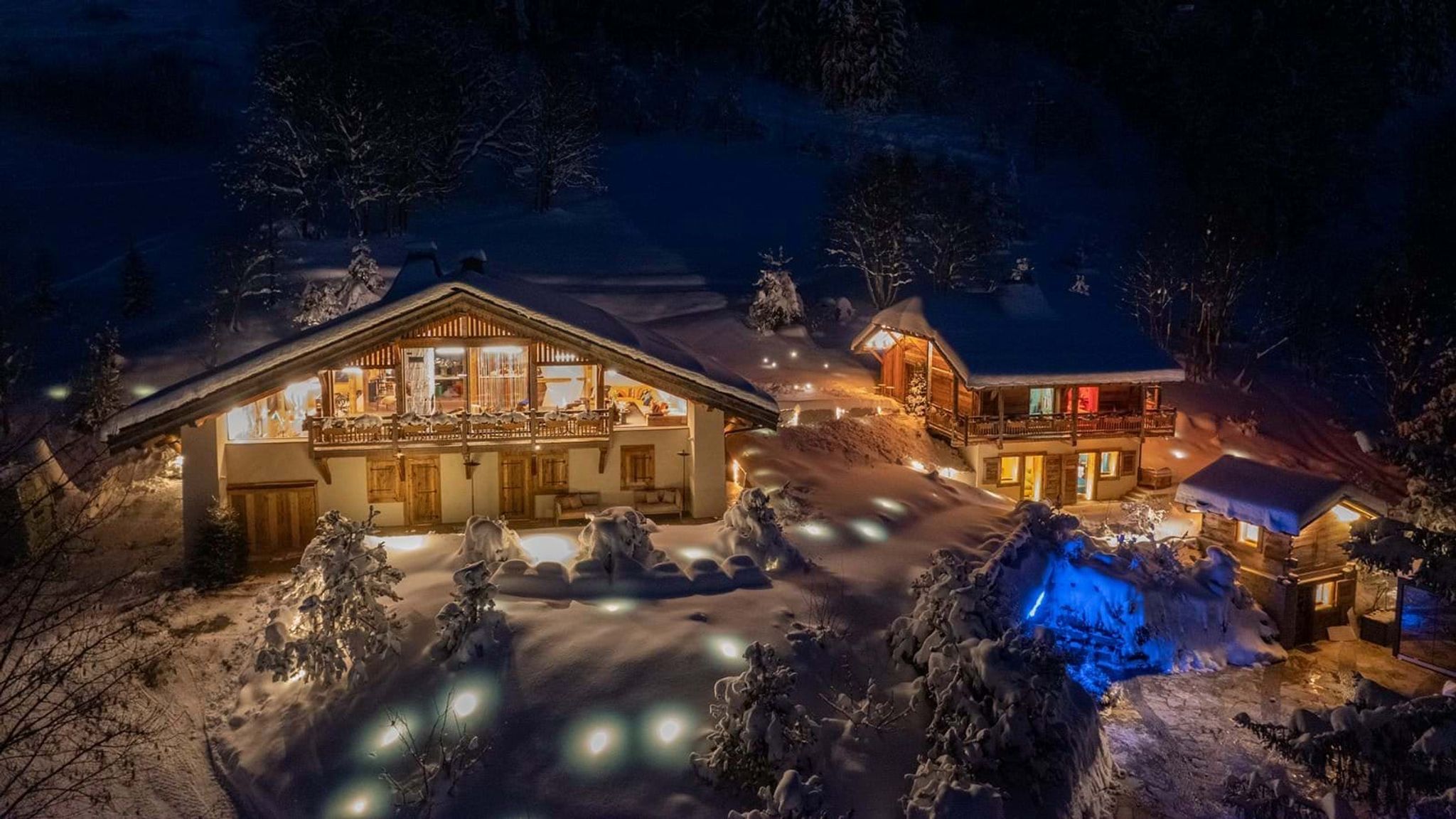
For a full terrain breakdown, see our Megève ski resort guide.
Getting there: Geneva airport is 75 minutes by car. Chambéry is 90 minutes. A dedicated helicopter transfer takes 20 minutes from Geneva.
Chamonix: A Real Town That Happens to Have Skiing

Chamonix is the only entry on this list that functions as a genuine year-round mountain town rather than a seasonal resort. Its permanent population of 9,000 supports independent shops, a cinema, a sports centre, bars that stay open in summer, and a cultural life that doesn't hibernate when the snow melts. The town sits at the foot of Mont Blanc, and that proximity to Europe's highest peak shapes everything — from the serious alpinism culture to the type of visitor it attracts.
The skiing is split across five separate areas — Grands Montets, Brévent-Flégère, Le Tour-Balme, Les Houches, and the Aiguille du Midi — none of which is linked. This means bus rides between sectors, which suits independent skiers who plan their days around conditions rather than convenience. Grands Montets, in particular, offers some of Europe's most demanding lift-accessed terrain.
Chamonix's dining scene runs deeper than most ski towns. Rue du Docteur Paccard and the surrounding streets hold over 80 restaurants, from Nepalese canteens to serious French gastronomy. The après-ski is similarly diverse — Chambre Neuf for Scandinavian-inflected drinks, MBC for craft beer, Jekyll & Hyde for late nights.
A notable 91% include hot tubs, and over half have private pools — a higher ratio than most French resorts.
For a full terrain breakdown, see our Chamonix skiing guide.
Getting there: Geneva airport is 70 minutes by car through the Mont Blanc tunnel approach, or 90 minutes via the Autoroute Blanche. Chamonix also has a direct rail connection from Saint-Gervais.
Val d'Isère: Where Village Character Meets Serious Terrain
Val d'Isère offers the rarest combination in French skiing: a genuine stone-and-wood village centre paired with 300 kilometres of high-altitude terrain in the Espace Killy. The pedestrian main street runs roughly 800 metres from the Rond-Point des Pistes to the church, lined with independent shops, equipment stores, and restaurants that maintain quality because the clientele expects it.
The town sits at 1,850 metres — high enough for reliable snow from late November through early May. The Face de Bellevarde, visible from the village centre, hosted the 1992 Olympic men's downhill and remains one of the most demanding marked runs in France. Off-piste options extend into the Pisaillas glacier and the backcountry around the Col de l'Iseran.
Evening life in Val d'Isère is distinct from the megaclub culture of some Austrian resorts. La Folie Douce at the mid-station provides the afternoon party; the village itself settles into a more considered pace after dark. Cocorico, Le Blizzard's restaurant, and the Edelweiss all reflect a town that takes its food seriously.
For a full terrain breakdown, see our Val d'Isère skiing guide.
Getting there: Chambéry airport is 2 hours by car. Geneva is 3.5 hours. Lyon is 3 hours. Transfer times are the main trade-off for Val d'Isère's altitude advantage.
Morzine: The Savoyard Village With Six Hundred Kilometres on Its Doorstep

Morzine is a working Savoyard farming village that happens to sit at the centre of the Portes du Soleil — one of the two largest linked ski areas in the world, with 600 kilometres of piste spanning France and Switzerland. The town's character comes from its architecture: dark-wood chalets with wide balconies, a 17th-century church at the centre, and narrow lanes that feel proportioned for people rather than cars.
The village operates as a genuine community. The Tuesday market brings locals from surrounding valleys. Independent bakeries, butchers, and fromageries serve residents alongside visitors. The Palais des Sports hosts ice hockey matches and swimming. Morzine feels inhabited in a way that purpose-built stations do not.
Skiing directly from Morzine accesses the Pléney and Nyon sectors, with the Super Morzine gondola linking to Avoriaz and the broader Portes du Soleil. The terrain suits confident intermediates and families — the steepest challenges require venturing to the Swiss side at Champéry or Les Crosets.
For a full terrain breakdown, see our Morzine skiing guide.
Getting there: Geneva airport is just 75 minutes by car, making Morzine one of the most accessible French ski towns for weekend trips.
Méribel: Purpose-Built Done Right
Méribel is a rare example of a purpose-built resort that reads as a genuine village, thanks to strict chalet-style building codes dating to its 1938 founding by Scottish colonel Peter Lindsay. Every structure must use local stone and wood — a planning rule that gives the town an architectural coherence most modern resorts lack.
The town stretches along a valley between three distinct villages, each with its own character. Méribel Centre is the social hub: Le Rond-Point draws the afternoon après crowd, Le Blizzard's brasserie serves serious Savoyard cuisine, and the Chaudanne lift station anchors a walkable commercial strip. Méribel Village, slightly lower, is quieter and more residential. Mottaret, at the top, prioritises ski-in convenience over village atmosphere.
The dining scene has matured considerably. L'Ekrin holds a Michelin star, Le Plantin serves refined mountain dishes in a converted farmhouse, and the crêperie La Fromagerie on Rue de la Chaudanne stays packed with locals. Evening life is measured rather than raucous — a welcome contrast to some of the Tarentaise's louder neighbours.
Méribel's position at the geographic centre of the Trois Vallées gives it an unmatched advantage for terrain access. The local Méribel-Mottaret sector holds 70 kilometres of runs, with the full 600-kilometre network reachable in every direction. For a full terrain breakdown, see our Méribel skiing guide.
Forty properties provide full catering, and 105 accommodate groups of 10 or more — making Méribel one of the strongest options for large group ski holidays in the Trois Vallées.
Getting there: Chambéry airport is 90 minutes. Lyon is 2.5 hours. Geneva is 2.5 hours. The Méribel road from Moûtiers is well-maintained but can be slow on Saturday changeover days.
St Martin de Belleville: The Trois Vallées' Quiet Heart
St Martin de Belleville is the least developed gateway to the Trois Vallées — and that restraint is the entire point. The village retains its 16th-century Savoyard architecture, a Baroque church, a handful of traditional restaurants, and a pace of life that feels closer to a farming hamlet than a ski resort. La Bouitte, the village's three-Michelin-starred restaurant, alone justifies the detour for food-focused travellers.
A gondola from the village centre connects to the Saint-Martin Express, which feeds into the Méribel valley and the wider Trois Vallées. The local skiing is modest — a few blues and reds down to the village — but the full 600-kilometre network opens up within two or three lifts. The trade-off is that reaching Courchevel or Val Thorens takes time; St Martin rewards those who prioritise village life over piste kilometres per day.
Getting there: Chambéry airport is 100 minutes. Moûtiers, the nearest rail station, is 20 minutes by car.
Les Gets: The Family Village With Portes du Soleil Access
Les Gets has maintained its wooden-chalet streetscape and pedestrian village core while neighbouring stations expanded into larger, more commercial operations. The result is one of the Portes du Soleil's most walkable bases — a compact centre where the fromagerie, boulangerie, and ski hire shop sit within 200 metres of each other.
The village's cultural identity runs deeper than most ski towns its size. The Musée de la Musique Mécanique, housed in a former church, holds over 500 mechanical instruments. The Place de la Mairie hosts a weekly market during the season, and the annual Crankworx mountain bike festival brings a summer community that keeps businesses viable year-round.
Les Gets' evening atmosphere is family-oriented rather than party-driven. The Wild Hare and Le Boomerang on the main street provide low-key options, while Le Vina serves bistro dishes that would hold their own in a larger town. The Ferme de Montagne, a converted alpine dairy, offers a more refined evening for couples.
The skiing accesses the Mont Chéry sector and the main Portes du Soleil circuit via the Chavannes gondola — one of the largest linked networks in the world at 600 kilometres. For more detail on terrain, see our Les Gets ski resort guide.
Getting there: Geneva airport is 60 minutes — the shortest transfer of any town on this list. The proximity makes Les Gets particularly appealing for short breaks and weekend trips.
Courchevel 1850: The Benchmark for Alpine Refinement

Courchevel 1850 is the most developed luxury ski town in France and arguably in Europe. Its main street concentrates high-end retail — Chanel, Louis Vuitton, Dior — alongside serious restaurants like Le 1947 (three Michelin stars) and Baumanière 1850. The town functions as a self-contained destination where the après-ski economy rivals the skiing itself.
The altitude village at 1,850 metres provides direct access to the Trois Vallées via the Saulire gondola and the Verdons lift system. Local runs descend through well-groomed terrain, and the 1850-to-Le Praz descent through forest is one of the more satisfying end-of-day runs in the Alps. The altiport — a short mountain runway — adds a theatrical arrival option that no other resort on this list offers.
Courchevel's evening atmosphere is the most formal in the French Alps. Dress codes apply at several restaurants, and the bar scene skews toward champagne and cocktails rather than beer and shots. This suits a specific traveller; others may find it slightly performative.
Twenty percent offer private chef service, and 95% provide ski-in ski-out access.
For a full terrain breakdown, see our Courchevel skiing guide.
Getting there: Chambéry airport is 100 minutes. Lyon is 2.5 hours. Geneva is 3 hours. The Courchevel altiport accepts private aircraft and helicopter transfers.
How to Choose Between These Eight Towns
The right French ski town depends on what you value most between lifts. Use this decision framework:
Prioritise town character: Megève or St Martin de Belleville. Both offer genuine village identity that exists independently of skiing, with Megève at a higher price point and St Martin offering Three Valleys access at a fraction of the cost.
Prioritise terrain access: Val d'Isère or Méribel. Val d'Isère pairs village character with the Espace Killy's 300 kilometres; Méribel sits at the centre of the Trois Vallées' 600 kilometres.
Prioritise value and accessibility: Morzine or Les Gets. Both are under 75 minutes from Geneva, offer the Portes du Soleil's 600 kilometres, and provide genuine Savoyard village life at lower prices than Tarentaise resorts.
Prioritise a real town, not a resort: Chamonix. Year-round population, independent shops, diverse dining, and a mountaineering culture that no purpose-built station can replicate.
Prioritise luxury services: Courchevel 1850. The deepest concentration of catered chalets, private chefs, and high-end hospitality in the French Alps.
Deciding between two of these towns in particular? Our head-to-head guides go deeper — Courchevel vs Méribel on the Three Valleys' two flagship bases, and Chamonix vs Morzine on rugged mountain town versus relaxed Savoyard village.
Browse by resort, filter by amenities, or explore all French destinations to find the right base for your next ski holiday.
Frequently Asked Questions
What is the most charming ski town in France?
Megève and St Martin de Belleville consistently rank as the most charming French ski towns. Megève offers a medieval pedestrian centre, Michelin-starred dining, and 1920s architectural heritage. St Martin de Belleville retains its 16th-century Savoyard character and provides quieter access to the Trois Vallées. Both prioritise village atmosphere over resort infrastructure.
Which French ski town is closest to Geneva airport?
Les Gets is the closest major French ski town to Geneva airport at approximately 60 minutes by car. Morzine follows at 75 minutes, and Megève at 75 minutes. All three sit in the northern French Alps, making them practical choices for short breaks and weekend trips from the UK and northern Europe.
What is the best French ski town for families?
Morzine and Les Gets are the strongest options for families. Both offer genuine village life, compact walkable centres, well-regarded ski schools, and accommodation prices below the Tarentaise valley average. Les Gets' pedestrian core is particularly manageable for families with young children, while Morzine provides more dining variety and a larger community feel.
Which French ski town has the best restaurants?
Megève holds three Michelin-starred restaurants — the highest concentration of any ski town in France. St Martin de Belleville's La Bouitte has held three Michelin stars since 2015. Courchevel 1850 offers Le 1947 (three stars) and several one-star establishments. Val d'Isère and Chamonix round out the top tier with growing independent dining scenes.
Is it better to stay in a French ski town or a purpose-built resort?
French ski towns offer superior dining, architecture, and evening atmosphere but typically require more effort to reach the slopes — a short drive, bus, or gondola rather than stepping out of your door. Purpose-built resorts like Val Thorens or Les Arcs maximise ski-in convenience but lack independent shops, historic character, and the sense of visiting a real place. The eight towns in this guide strike the best balance between the two.
What is the most affordable ski town in France?
Both provide access to the Portes du Soleil's 600 kilometres of terrain, short Geneva transfers, and genuine village character — strong value compared to Tarentaise valley alternatives.


