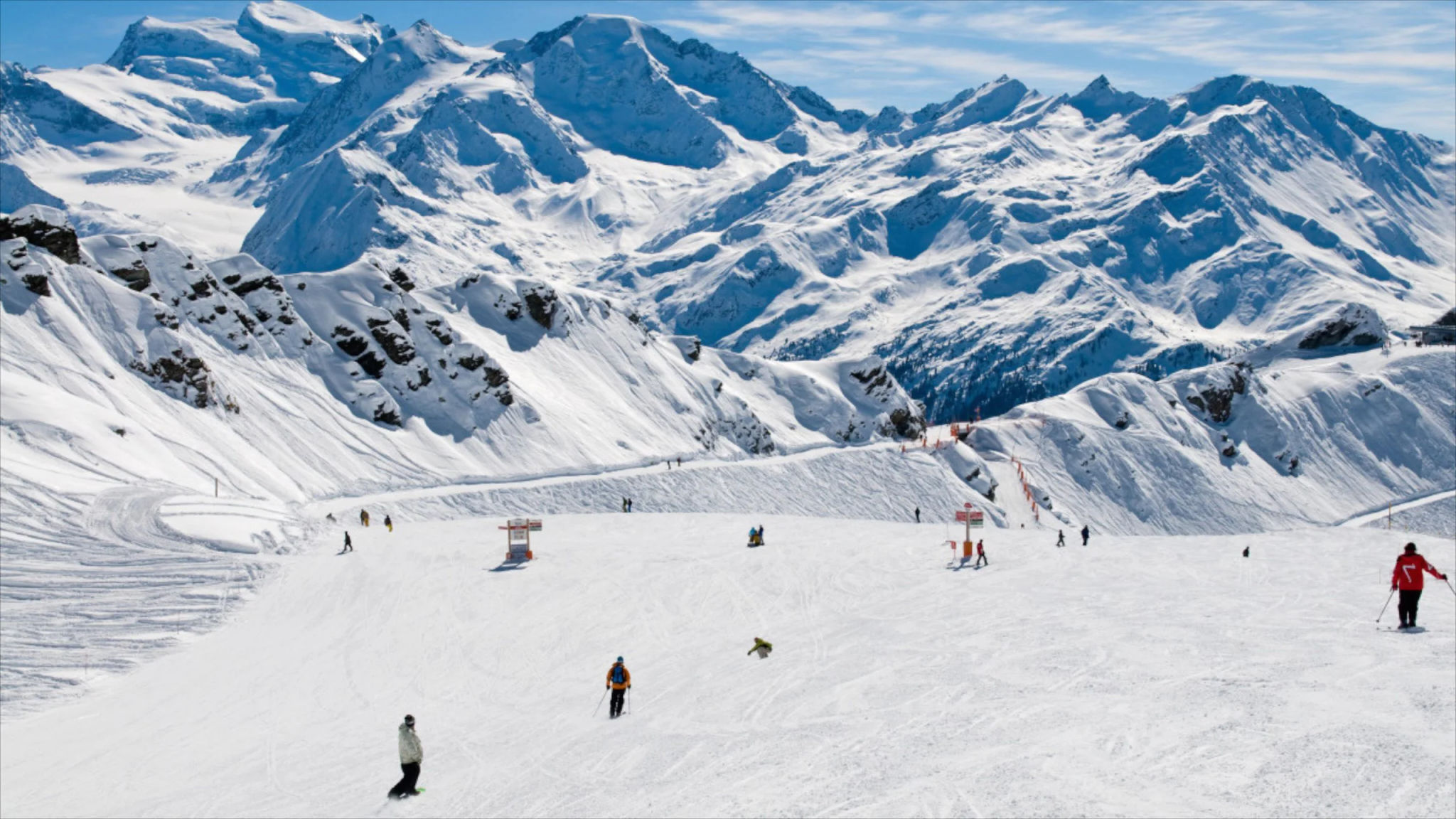

Switzerland's two most storied resorts pull in similar crowds for very different reasons. Verbier is the rowdy, sun-drenched darling of expert skiers and freeriders; St. Moritz is the polished birthplace of alpine winter tourism, where the skiing is almost an accessory to the lifestyle. Both can claim world-class terrain, both can claim genuine glamour, and both reward a serious booking budget. Choosing between them comes down to what kind of week you actually want.
The Skiing
Verbier sits at the gateway to the 4 Vallées, the largest interconnected ski area in Switzerland, with 412km of marked pistes and a top lift at 3,330m on Mont Fort. The bones of the resort are built around big-mountain skiing: long verticals, exposed ridges, and a network of itineraries that has earned Verbier its reputation as one of the planet's premier off-piste destinations. The Tortin descents and the Bec des Rosses freeride face, used annually by the Freeride World Tour, are the postcards. Behind them sits well over 100km of off-piste terrain.
St. Moritz offers roughly 350km of pistes, but the experience is structured very differently. The terrain is split across three non-linked sectors: Corviglia above the village, the higher and snow-sure Corvatsch, and the dramatic Diavolezza/Lagalb pairing further down the Engadin. Corviglia is the resort's intermediate engine room with wide, sunny, south-facing reds; Corvatsch delivers the colder snow and the freeride lines; Diavolezza adds glacier scenery and a famous unpatrolled descent toward the Morteratsch glacier.
In practice, Verbier is the better choice if you want one vast, connected playground with serious expert credentials and glacier skiing at the top. St. Moritz suits skiers who are happy to hop between distinct mountains by bus and train, and who place sunshine, cruising and scenery above raw vertical and off-piste mileage.
The Village & Après-Ski
Verbier's village is a sun-trap terrace at 1,500m, traditional in silhouette but thoroughly contemporary in attitude. Après starts on the mountain at Le Rouge and Bar 1936, rolls down to Pub Mont Fort for the late afternoon crush, then escalates through the Farinet Lounge Bar and on into the Farm Club, the resort's long-standing late-night institution. It is loud, expensive and intentionally theatrical.
St. Moritz operates on an entirely different frequency. The village is split between St. Moritz Dorf, with its luxury boutiques, grand hotels and Michelin kitchens, and St. Moritz Bad, the spa-focused valley floor. Après is more refined than rowdy: Hauser's Rooftop Bar for an elegant terrace drink, Devil's Place at the Waldhaus am See for one of the world's deepest whisky collections, and dinners at IGNIV by Andreas Caminada inside Badrutt's Palace or the legendary Chesa Veglia.
If your ideal evening involves shouting over a DJ set with ski boots still on, Verbier wins on the night. If it involves a long tasting menu, a fur coat and a quiet nightcap by the lake, St. Moritz is in a category of its own.
Getting There
Verbier is the easier transfer from the UK. Geneva Airport sits around 170km away, roughly 1h 45min to 2 hours by car, with Alpybus and private services running shared and chauffeured transfers. There is also a clean rail option via Martigny to Le Châble, then a gondola directly up to the village. Sion, just 45 minutes away, is the private jet base of choice.
St. Moritz rewards travellers who are willing to slow down. Zurich is the natural gateway at roughly 210km and 2h 45min by road, but the Rhaetian Railway from Chur is one of the most scenic train rides in Europe and arguably the more elegant way in. The town has its own station and a genuinely world-class local bus and train network that is included with your ski pass.
Within resort, Verbier is car-friendly with parking at most properties, while St. Moritz actively discourages driving in favour of its public transport. Most luxury hotels in the Engadin provide private shuttles for guests, so a hire car is largely unnecessary.
When to Visit
The Verbier season is confirmed for 6 December 2025 to 26 April 2026, with the main sector open throughout, Savoleyres closing slightly earlier and Bruson running from mid-December to early April. Average snowfall sits in the 4.25-5.5m range, and the glacier on Mont Fort underwrites snow reliability at the top of the mountain.
St. Moritz runs from late November to early May, slightly longer at both ends, supported by extensive snowmaking and the famous Engadin climate that averages 322 days of sunshine a year. Snowfall is more modest at around 4m per season, but the altitude and the cold, dry microclimate keep conditions consistent.
For both resorts, early- and mid-January tend to offer the best value and quietest pistes. February half-term is the peak crush. March delivers longer days and softer light, and in St. Moritz especially, late season skiing under blue skies is the connoisseur's pick. Book lift passes online well in advance in either resort to access the better tariffs.
The Verdict
These are two of the most prestigious names in skiing, and neither will disappoint a discerning traveller. The choice is really about temperament.
Verbier is the better mountain holiday in the purest sense. The 4 Vallées is vast, the off-piste is genuinely world-class, the village has energy from first lift to last drink, and the access from Geneva is hard to beat. It is the resort for groups who want to ski hard all day and then commit to the evening with equal seriousness.
St. Moritz is the better destination if you are coming for the whole alpine theatre rather than just the skiing. The Engadin scenery is unmatched, the hotels are some of the finest in Europe, and there is enough to do off the slopes, from the Cresta Run to Snow Polo to lake walks, to keep a non-skiing partner genuinely occupied. The mountains are excellent; they simply are not the only point of the trip.
Choose Verbier if you want Switzerland's most exciting ski terrain and its loudest après. Choose St. Moritz if you want the most refined alpine address in the country, with skiing to match the lifestyle around it.
Frequently Asked Questions
Is Verbier or St. Moritz better for advanced skiers?
Verbier is the stronger choice for advanced and expert skiers, with legendary off-piste terrain, the Mont Fort glacier and the Freeride World Tour's home descents. St. Moritz has excellent expert terrain at Corvatsch, Diavolezza and Lagalb, but it is spread across separate sectors rather than one connected expert playground.
Which resort is easier to reach from the UK?
Verbier is the simpler transfer, sitting under two hours from Geneva Airport with both road and rail options. St. Moritz is around 2h 45min from Zurich by car, though many travellers prefer the scenic Rhaetian Railway approach via Chur, which is part of the experience.
Is St. Moritz suitable for non-skiers?
St. Moritz is arguably the best non-skier resort in the Alps. The village offers luxury shopping, fine dining, spas, the historic Cresta Run, ice skating on the frozen lake and high-profile winter events including Snow Polo, alongside scenic train rides and walking trails.
How does après-ski compare between the two?
Verbier's après is louder, livelier and built around iconic venues like Pub Mont Fort, the Farinet Lounge Bar and the Farm Club. St. Moritz leans toward elegant terrace drinks, world-class dining and refined bars such as Devil's Place, with far less of the boots-on dancing tradition.
Which resort offers better value?
Neither is a budget destination, but both reward early booking. Lift passes start at roughly CHF 82 a day in Verbier and CHF 85 in St. Moritz, with six-day passes around CHF 410 in each. Booking online at least 10 to 15 days in advance can unlock discounts of 15% in Verbier and up to 30% via St. Moritz's dynamic Snow-Deal pricing.