The Skiing
These are two of the most celebrated ski resorts in the Alps, but their terrain could hardly be more different in character.
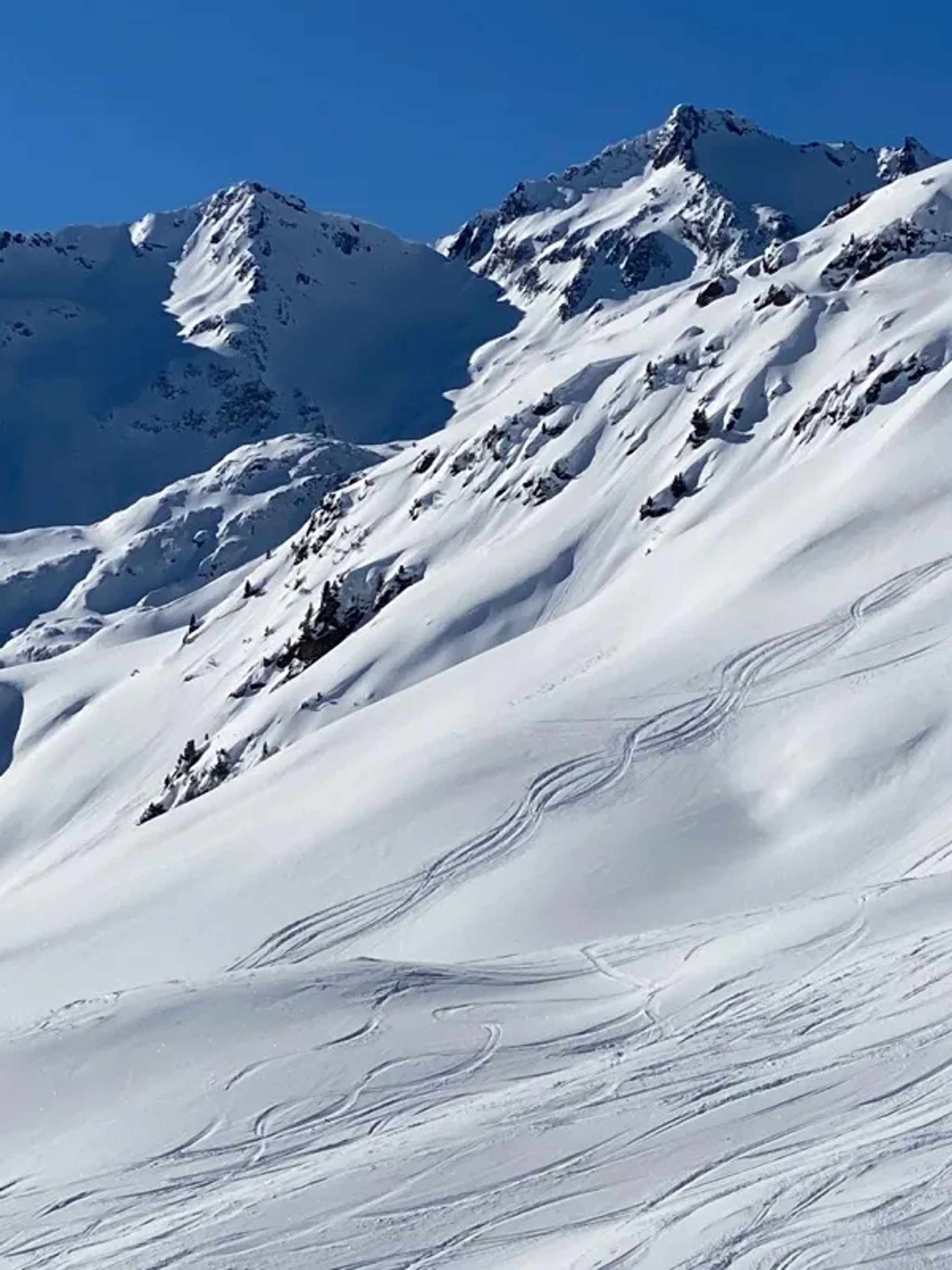
St. Anton sits at the heart of Ski Arlberg — 305km of linked terrain spanning St. Anton, Lech, Zurs, Stuben, St. Christoph, and Warth-Schrocken. This is one of the great ski areas in the world, and St. Anton commands the most demanding corner of it. The runs off the Valluga (2,811m) are steep and exposed, the north-facing slopes above Stuben hold powder for days, and the off-piste between St. Anton and Lech is among the finest lift-accessed freeride terrain in Europe. The pisted runs are demanding too — long, steep reds and blacks that reward strong technique. Intermediates are well served on the Galzig and Gampen sectors, but this is a resort that fundamentally caters to confident skiers.
Kitzbuhel offers 170km of pistes across the KitzSki area, with the Kitzbuheler Alpen SuperSki pass unlocking additional terrain in the surrounding region. The skiing is more varied and more forgiving than St. Anton's. Rolling intermediate runs dominate the Hahnenkamm and Kitzbuheler Horn sectors, and the grooming is superb. The Streif — the Hahnenkamm downhill course — is the most famous race piste in skiing, and you can ski it yourself (though the gradient at the Mausefalle will make you question that decision). The terrain is excellent for mixed-ability groups, with long cruising runs, tree-lined descents, and enough steeps to keep advanced skiers engaged. The weakness is altitude: Kitzbuhel's village sits at just 800m, and the highest lift-served point reaches 2,000m. Heavy investment in snowmaking compensates, but on a warm week in late season, St. Anton's higher terrain has a clear advantage.
For expert skiers and freeriders who want serious terrain, St. Anton is the obvious choice. For groups with a spread of ability levels who want well-groomed pistes and the thrill of skiing a World Cup course, Kitzbuhel delivers.
The Village & Apres-Ski
Both villages have strong identities, but they appeal to quite different sensibilities.
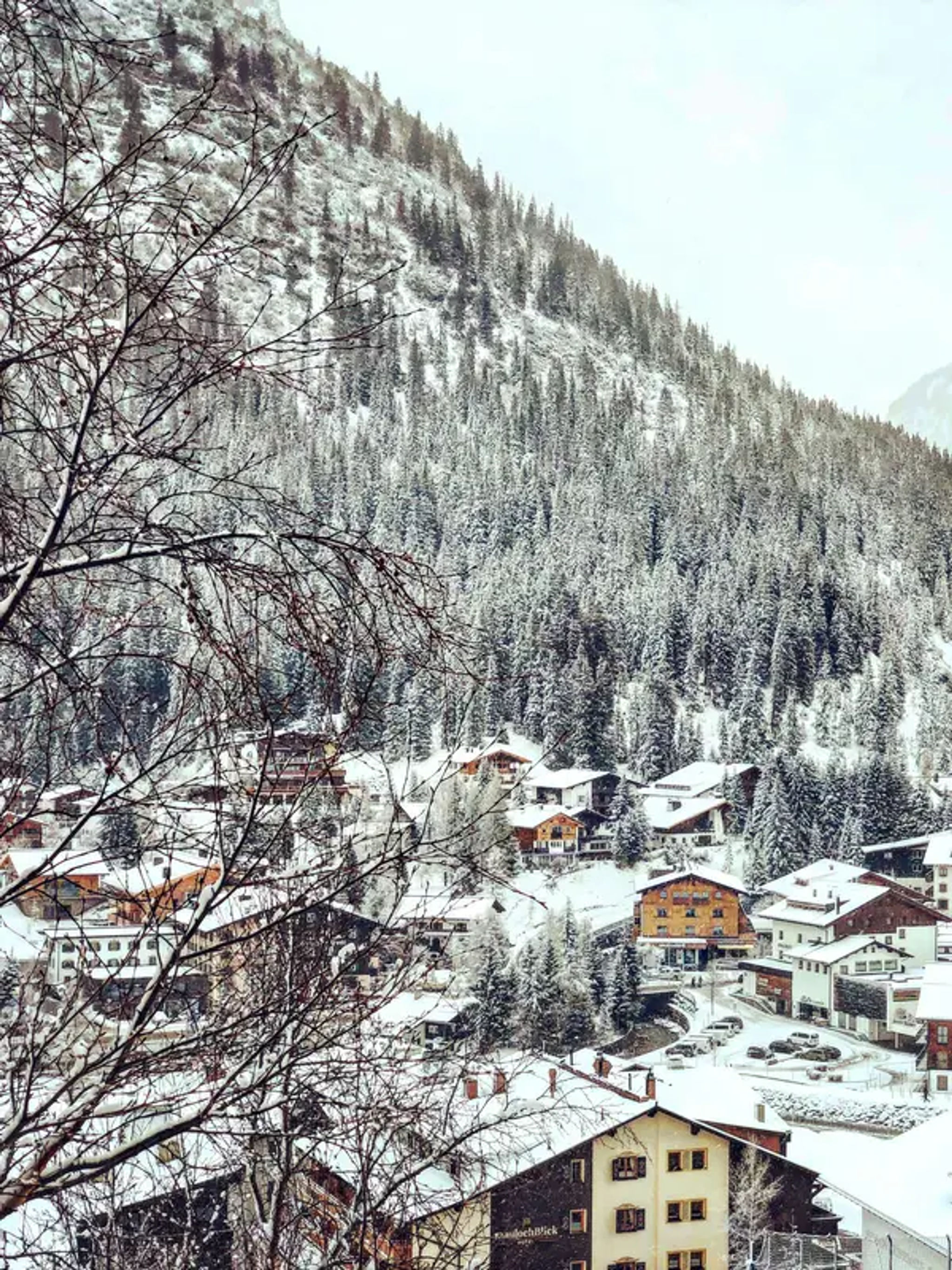
St. Anton is a proper Tyrolean ski village — traditional wooden buildings, a church spire, and a single main street that comes alive at 3pm when the lifts start emptying. This is the birthplace of modern apres-ski, and it hasn't lost its edge. The Mooserwirt and Krazy Kanguruh, both on-mountain above the village, are where the afternoon session begins — table-dancing in ski boots, DJ sets in the open air, beer by the litre. By early evening the energy migrates down to the village bars along the main strip. It's raucous, social, and unapologetically fun. The atmosphere skews younger (25-40), though families are well catered for too. Dining runs from hearty Tyrolean fare to a handful of refined options. St. Anton is a resort where skiing and socialising are inseparable — the mountain and the party feed off each other.
Kitzbuhel is something different entirely. This is a genuine medieval town — founded in the 12th century, with cobbled streets, pastel-painted townhouses, a Gothic church, and a pedestrianised centre that would be charming even without the skiing. The town has a year-round identity that most ski resorts lack: boutiques, galleries, a casino, and a cultural calendar that runs through summer. The apres-ski is strong but more town-based than on-mountain — The Londoner and Stamperl are popular gathering points, and the atmosphere is convivial rather than chaotic. The dining scene is a genuine strength, with one or two restaurants at Michelin level and a deep bench of excellent Austrian and international kitchens. Kitzbuhel suits couples, families, and groups who want a sophisticated base with substance beyond the slopes.
If you want legendary on-mountain apres and a buzzing village atmosphere, St. Anton is the answer. If you want a beautiful, historic town with refined dining and a more understated social scene, Kitzbuhel wins.
Getting There
Both resorts are in the Tyrol, and both benefit from strong road and rail connections — a major advantage of Austrian skiing.
St. Anton: Innsbruck airport is the closest option at approximately 1 hour 15 minutes by road. Zurich is viable at around 2 hours 30 minutes, with the scenic drive through the Arlberg Pass (or tunnel in winter). St. Anton has its own mainline railway station — one of very few major ski resorts you can reach directly by train. Regular services connect through Innsbruck, and overnight sleeper trains from various European cities make it one of the most accessible resorts in the Alps by rail.
Kitzbuhel: Also well connected. Innsbruck is approximately 1 hour by road, Salzburg around 1 hour 30 minutes, and Munich roughly 1 hour 45 minutes. Like St. Anton, Kitzbuhel has its own train station with direct connections, making car-free holidays entirely practical. The choice of three major airports gives flexibility on flights, and the transfer times are among the shortest for any top-tier Austrian resort.
Both resorts are notably easier to reach than many French equivalents — no winding mountain roads and no three-hour transfers from Geneva. For UK and northern European skiers, the combination of short transfers and train access is a real advantage.
When to Visit
The resorts have different optimal windows, driven largely by the altitude gap between them.
St. Anton's village sits at 1,304m, with skiing reaching 2,811m at the Valluga summit. This higher altitude, combined with the Arlberg's favourable snowfall patterns (it's one of the snowiest corners of the Alps), means the season runs reliably from early December through late April. January and February deliver the most consistent conditions. March brings longer days and often excellent snow stability for off-piste touring. The Hahnenkamm downhill race in Kitzbuhel (late January) is worth planning around if you're in Kitzbuhel — it transforms the town for a week.
Kitzbuhel's lower altitude (800m village, 2,000m top station) makes it more weather-dependent. The resort invests heavily in snowmaking — over 1,000 snow cannons cover the majority of the piste network — but a warm spell in early December or late March can thin coverage at lower elevations. The sweet spot is mid-January through mid-March. The Hahnenkamm race week, typically the third or fourth weekend of January, is the highlight of the Austrian racing calendar — the atmosphere in town is electric, and tickets are surprisingly accessible if you plan early.
For the longest, most reliable snow window, St. Anton has the edge. For a specific event-driven trip with unbeatable atmosphere, Hahnenkamm week in Kitzbuhel is hard to beat.
The Verdict
These are Austria's two most famous ski resorts for good reason. Both deliver a superb holiday, but they cater to different priorities.
Choose St. Anton if you want: one of the great linked ski areas in the world with 305km of terrain; serious off-piste and steep skiing that rewards strong technique; the most famous apres-ski scene in the Alps; a high-altitude resort with reliable snow from December to April. St. Anton is a skier's resort first and foremost — the terrain is the main event, and the apres is the encore.
Choose Kitzbuhel if you want: a beautiful medieval town with genuine year-round character; the chance to ski the legendary Hahnenkamm Streif; excellent dining and a more refined social scene; well-groomed terrain that suits mixed-ability groups; the spectacle of the Hahnenkamm race if you time it right. Kitzbuhel is the resort for skiers who value the whole experience — the town, the food, the history — as much as the skiing itself.
The honest answer: these two resorts complement each other beautifully, and many Austrian skiing devotees alternate between them. A week in each across a season would cover most of what Austrian skiing has to offer.
Frequently Asked Questions
Is St. Anton or Kitzbuhel better for beginners?
Neither is ideal for a first-timer compared to purpose-built resorts, but Kitzbuhel has the edge. Its nursery areas are well-positioned, the progression to gentle blues is natural, and the grooming quality makes learning more comfortable. St. Anton's beginner areas at Nasserein and Gampen are adequate, but the surrounding terrain is steep, and the resort's culture and reputation attract strong skiers — beginners can feel out of place. For a first ski holiday, Kitzbuhel is the better of the two.
Which resort has better snow — St. Anton or Kitzbuhel?
St. Anton, by a clear margin. Its village altitude (1,304m) is 500m higher than Kitzbuhel's (800m), and the Arlberg region receives significantly more natural snowfall — typically 7-9 metres per season versus Kitzbuhel's 4-5 metres. The north-facing slopes above St. Anton hold snow well, and terrain reaches 2,811m. Kitzbuhel compensates with one of the most extensive snowmaking systems in the Alps, but when conditions are marginal, St. Anton will always have the better coverage.
Can you ski from St. Anton to Kitzbuhel?
No. St. Anton is part of the Ski Arlberg area in western Tyrol, and Kitzbuhel sits in the east of the region. They are approximately 2 hours apart by car (around 170km via the Innsbruck autobahn). Some skiers combine both in a two-centre holiday, spending time in each — the train connection between the two towns makes this practical.
When is the Hahnenkamm race in Kitzbuhel?
The Hahnenkamm races take place annually in late January, typically over a long weekend (Friday to Sunday). The downhill on Saturday is the centrepiece — the Streif course is considered the most demanding on the World Cup circuit. The town fills up for the week, with events, parties, and a festival atmosphere. Accommodation books well in advance, but the race itself is free to watch from many vantage points along the course.
Which resort is better for a group ski holiday?
It depends on the group. For a group of strong skiers who want challenging terrain and vibrant nightlife, St. Anton is hard to beat — the Arlberg's scale and the apres-ski culture create a memorable week. For a mixed-ability group or a trip where non-skiing partners and dining quality matter as much as the pistes, Kitzbuhel's town charm, restaurant scene, and varied terrain make it the more versatile choice. Both resorts have excellent luxury chalet accommodation suited to groups.